Times of crisis have produced strong artistic movements throughout history. Printmaking has played an important role in both political propaganda and forms of protest and activism.
This resource will guide students through a series of discussions and creative explorations centered around protest, advocacy, and collective action. Through close looking, reflection, and dialogue, students will examine how artists use visual language to express personal and societal concerns. Students will be encouraged to explore topics that resonate with their own values and viewpoints.
Close Looking
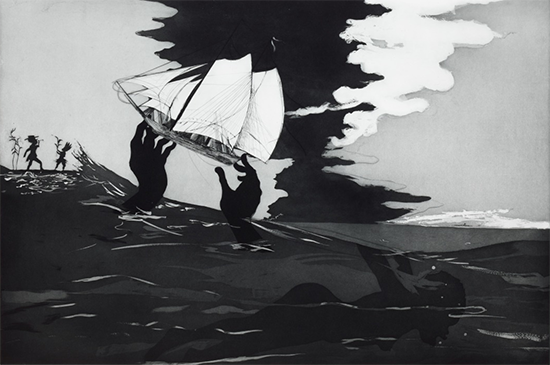
Help the students take a closer look at no world by Kara Walker. Project the image large enough so that everyone can see. Allow students time to think about and/or write down their answers to these questions. Then, allow for a whole group share-out.
- Look at the image.
- What do you notice?
- What story do you think this artwork is telling?
- What emotions do you feel when looking at this artwork? Why?
Questions to Dig Deeper
- What emotions do you think the artist wants the audience to feel?
- How can art inspire people to act, think differently, or feel connected to a cause?
- What do you think Kara Walker wants us to remember or question about history through this work? How might remembering the past connect to things people stand for today?
- Who seems to be in control and who doesn’t? What do you think the artist wants you to notice?
Activity: Examples of Protest
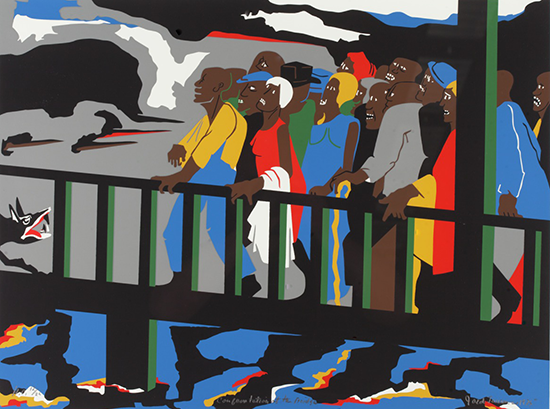
Help the students take a closer look at Confrontation at the Bridge by Jacob Lawrence. Project the image large enough so that everyone can see.
In pairs, students will discuss what they think is being protested and/or what is happening in the artwork. In a group, discuss the following:
- What emotions do you notice in how the figures are arranged? How does that affect how you view the scene?
- Whose perspectives or voices do you think are being centered in this artwork? And whose might be missing?
- How does this moment from history connect to issues or movements you’ve seen or experienced today?
As a group, begin to list different examples of social justice topics, issues, and reasons to protest. Some examples of social justice issues include the gender pay gap, income inequality, climate change, food insecurity, the refugee crisis, universal healthcare, poverty, gender-based violence, state violence, threats to the trans community, eroding democracy, political extremism, reproductive rights, racism, etc.
After listing your class’s examples, allow students to write down their answers to the following prompts to help them brainstorm social justice topics that are meaningful to them:
- What do you stand for?
- What is something you wish more people cared about or understood? Why does it matter to you?
- What makes you feel hopeful or inspired to act?
- What message would you put on a sign or poster for others to see? Why that message?
Activity: Advocacy Through Printmaking
Prior to this activity, discuss what printmaking is and the process of relief printing.
In the previous activity, students brainstormed a social justice issue that they stand for and that inspires them to act. In this activity, students will create a visual representation of their protest through words or images.
- Students will start off by sketching their protest prints.
- Depending on the printing material, students will prep their printing plates. For example, if students are using linoleum, they will transfer and carve their prints. If the students are using Styrofoam, they will etch their images into the Styrofoam plate with a pencil or toothpick.
- Students will apply ink to their printing plates and place paper to pull the print.
- Clean up.
Contextual Information: Confrontation at the Bridge
When Jacob Lawrence was commissioned to execute a print to celebrate the United States’ bicentennial in 1976, he illustrated the March 7, 1965, march by unarmed protesters objecting to the denial of African Americans’ right to vote. The march began in Selma, Alabama, but before the 600 protesters could reach the state capital in Montgomery, law enforcement officials attacked them with clubs and tear gas as they crossed the Edmund Pettus Bridge; Lawrence symbolized the malicious and brutal attack by including the vicious dog at the left edge of the scene. Two days later, with court protection, Martin Luther King Jr. led 25,000 marchers to Montgomery. Outraged by the barbarity of the civil rights struggle, the U.S. Congress passed, and President Lyndon Johnson signed, the Voting Rights Act later that year. Lawrence’s strong colors and compact composition relay the intensity and injustice of the violence inflicted on the peaceful protesters.
Contextual Information: no world
In her series of six etchings, titled An Unpeopled Land in Uncharted Waters, Walker constructs enigmatic images that reflect on the traumatic history of the transatlantic slave trade and its legacy of violence and racial strife.
In no world, one of two prints from the series on view here, Walker ambiguously alludes to the futile prospects for slaves who were shipped to the Americas. With no real hope of freedom, the woman submerged in the ocean might be swimming to escape or drowning as a victim of shipwreck. Meanwhile, the caricatured figures on shore suggest an unsettling future for those who survive the treacherous journey.
Suggested Supplies
Paper, pencils, relief printmaking materials (such as linoleum or Styrofoam, ink, and brayers)
Additional Resources
Sometimes People March, by Teresa Allen (children’s book), 2020
https://philamuseum.org/collection/object/315502
https://www.clevelandart.org/art/1994.17
“The 100 Best Protest Songs of All Time” Playlist: https://open.spotify.com/playlist/76w3yd3T7KszWf8153AyvC
Images: Confrontation at the Bridge, 1975. Jacob Lawrence. Screenprint. Dallas Museum of Art, gift of Michael L. Rosenberg, 1994.246.3. © The Jacob and Gwendolyn Lawrence Foundation, Seattle/Artists Rights Society (ARS), New York; no world, 2010. Kara Walker. Etching with aquatint, sugarlift, spit-bite, and drypoint. Dallas Museum of Art, Mary Margaret Munson Wilcox Fund, 2010.39.1. © Kara Walker.