In this resource, students will explore how the five senses—sight, sound, touch, smell, and taste—can enhance their understanding and interpretation of artwork, history, and their own emotions. By engaging their senses, students will uncover new layers of meaning and emotion within art, creating a richer and more personal connection to what they see.
This multisensory approach encourages thoughtful reflection and emotional engagement, fostering a meaningful experience that activates personal reflection and connection across personal and collective histories.
Close Looking
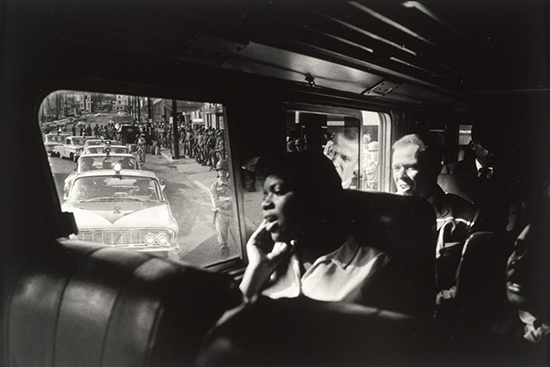
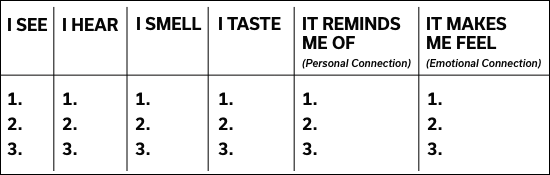
Help the students take a closer look at Freedom Ride by Bruce Davidson by using the following chart. Project the image large enough so that everyone can see. Allow students time to think about and/or write down their answers. Allow time for students to share within the group.
Questions to Dig Deeper
- How do you think understanding the emotions portrayed in an artwork can help us connect with American history?
- This photograph shows actual events in history. Imagine if you could step into the artwork for an hour. How did exploring with your senses help you engage more deeply with the work of art?
- There are many ways to protest. What is one way you have protested?
- How do you think the Freedom Rides impacted your life? How does that make you feel?
- In what ways might an artwork evoke different emotions for different viewers? Why do you think that happens?
- How does this artwork connect to your life today?
Activity: There Is More to the Picture
Invite students to imagine what might be happening beyond the edges of Freedom Ride by Bruce Davidson. If the artwork extended to the left or right, what scenes or stories might appear? Students will explore this idea through a fun and interactive Pictionary activity, working in pairs to creatively extend the narrative.
- Distribute whiteboard and markers (or paper and pencils) to each pair of students.
- Partner A will imagine and draw what they think could be happening to the left of the artwork. After 30 seconds, Partner B will have 10 seconds to guess the story or scene.
- Now, Partner B will draw what could be happening to the right of the artwork. After 30 seconds, Partner A will have 10 seconds to guess the story or scene.
- After completing one round, students will find a new partner and repeat the steps.
After this activity, students can discuss some of the following questions:
- How did imagining and drawing extended scenes help you connect more personally to the artwork?
- How did this activity change the way you see or think about the original artwork?
- What new ideas or emotions did you discover about the artwork?
- What story do you think the original artwork is trying to tell? How did your imagined scenes extend or add to that story?
Contextual Information
On May 4, 1961, 13 students, organized by the Congress of Racial Equality (CORE), began a Freedom Ride from Washington, DC, to New Orleans to challenge segregation laws in the South. One bus was firebombed and another was attacked by a mob, prompting the federal government to fly the riders to New Orleans. In response to the violence, students, ministers, and activists joined the cause. On May 24, 1961, 27 riders continued the journey from Montgomery, Alabama, to Jackson, Mississippi.
Bruce Davidson, a Magnum photographer, flew south after hearing the news reports of this new ride. Davidson later told Time magazine that he didn’t know what he would face and said, “I was brought up in the Midwest. . . . I didn’t have an understanding of what African Americans went through in the South.”
Davidson sat in on a “secret trip planning” meeting at the home of a local pharmacist, and despite having no official photography assignment, he got on the bus in Montgomery. Davidson stated, “I’d never been afraid of anything. But I knew something awful was going on. I knew it was dangerous for me to be on that bus.”
Crowds outside the bus taunted and shook their fists. The riders on the bus were singing as they began to head out of town under escort. Upon arriving in Jackson, the riders were immediately arrested on charges of inciting a riot, disturbing the peace, and failing to obey police orders. They were the first of nearly 400 students who would make the journey and be sent to a maximum-security prison for their peaceful protest.
“It sensitized me to something, something that needed to be recorded, something I had to bear witness to,” said Davidson, who followed the movement for four years, photographing everything from Malcolm X to a bullet-ridden car of a white woman who tried to advance the movement, up until the Selma March. Davidson said, “I was able to see America in a way I’d never seen it before.”
Suggested Supplies
Paper, writing utensils, white board, dry erase markers
Additional Resources
Watch Freedom Riders: https://www.pbs.org/wgbh/americanexperience/films/freedomriders/#part01
Image: Freedom Ride, 1961. Bruce Davidson. Black and white photograph. Dallas Museum of Art, anonymous gift, 2007.57.1. © Bruce Davidson.